Two pillow blocks on the same oven conveyor rarely fail on the same day. The one closest to the burner inlet usually goes first: the grease has oxidized into a brown varnish, the seal lip has hardened, and the insert bearing has lost the internal clearance it needs to run cool. By the time the squeal is audible, the shaft is often already scored.
The practical rule for high temperature pillow block bearings is simple. The real ceiling of the assembly is the lowest rating among four things: grease, seals, cage and internal clearance. The housing and the shaft fit matter, but they seldom set the limit. If the grease is rated to 120 °C, buying a heavier housing changes nothing.
Heat rarely damages the bearing steel itself. Standard chrome steel rings at 150 °C lose almost no hardness. What fails is everything around the steel.
Every grease has a base oil, a thickener and an oxidation life. Once the continuous temperature passes the thickener's limit, base oil evaporates and the thickener cokes. As a working rule, grease life roughly halves for every 15 K above its rated ceiling, so a block that ran three years at 90 °C may run three months at 135 °C. Reaching for a higher-temperature grease is the cheapest fix in the plant, provided the seal and cage can take the same temperature.
Nitrile (NBR) lips are comfortable to about 100 °C, fluorocarbon (FKM) to roughly 200 °C, and PTFE or labyrinth arrangements beyond that. A hardened lip stops wiping the shaft, and once grit enters, the failure accelerates. In very hot duty it is often better to run an open bearing with a labyrinth and a planned relubrication route than to fit an elastomer seal that will bake solid in a month.
A hot shaft grows faster than a cooler housing. On a 50 mm bore, a 100 K difference between inner and outer ring can consume roughly 25 to 30 µm of radial internal clearance, which is more than one full clearance step. That is why hot applications normally start at C3 or C4 rather than CN, and why a clearance measurement report is worth asking for.
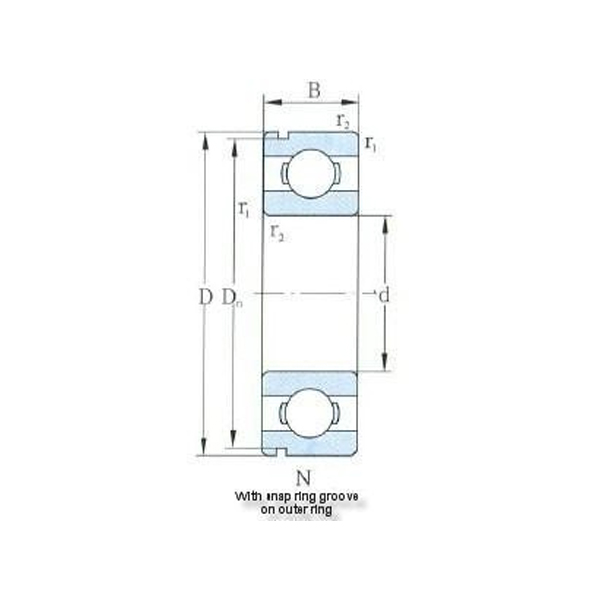
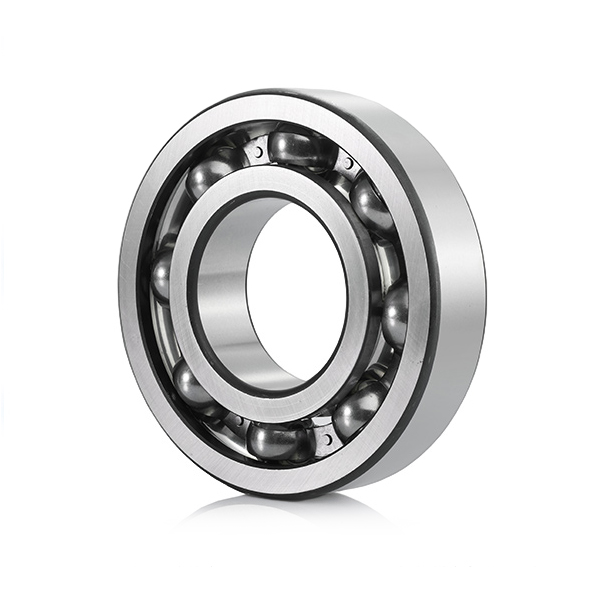
Polyamide cages are generally limited to about 120 °C. Pressed steel and machined brass cages carry the duty far higher. An insert bearing is essentially a deep groove ball bearing with a wide inner ring and a locking device, so the same deep groove ball bearing rules on cage material and ring stabilization apply.
The chart below shows where common pillow block configurations sit in continuous service. Treat the numbers as planning values, not guarantees: they assume correct mounting, correct clearance and a realistic relubrication interval.
Standard insert ball block, lithium grease, NBR seals: 100–120 °C
High-temperature insert block, synthetic grease, FKM seals: 180–220 °C
PTFE-thickened grease with PTFE seals: 240–260 °C
Solid lubricant with labyrinth sealing: 300–350 °C
Stabilized rings, special cage, solid lubricant: up to 400 °C
Short peaks of 20 to 30 K above these figures are usually survivable, but they cost grease life and they must be counted in the relubrication schedule rather than ignored.
For most ovens, dryers, paint lines and bakery tunnels, the workhorse remains the mounted pillow block with an insert ball bearing: two-bolt or four-bolt cast housing, wide inner ring, locking collar or setscrews, and a relubrication hole through the housing. It is inexpensive, self-aligning within a couple of degrees, and quick to replace on a shaft that has already been marked by a previous failure.
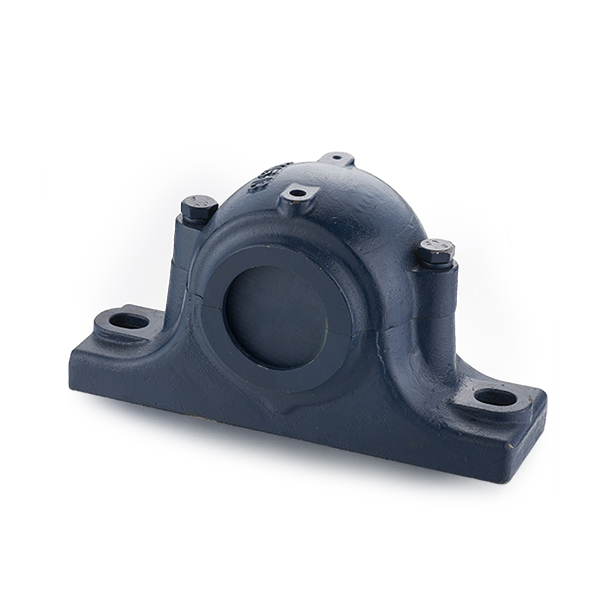 Mounted Pillow Block with Insert Ball BearingA practical workhorse for ovens, dryers and conveyor lines; check expansion pairing and shaft-locking method before specifying.View Product →
Two details deserve more attention than the catalogue photo. First, order expansion and non-expansion units as a pair: one bearing locks the shaft axially and the other floats, otherwise thermal growth loads whichever housing is weakest. A 1 m steel shaft heated by 200 K tries to grow about 2.3 mm. Second, check the locking method. Setscrews on a hardened shaft at 200 °C can creep under thermal cycling, while a properly torqued eccentric collar or an adapter sleeve holds far better.
| Configuration | Typical continuous limit | Lubrication | Sealing | Typical duty |
|---|---|---|---|---|
| Standard insert ball pillow block | 100–120 °C | Lithium grease | NBR lip seals | Conveyors and fans with ambient below 100 °C |
| High-temperature insert ball pillow block | 180–220 °C | Synthetic or PTFE-thickened grease | FKM or PTFE seals | Ovens, dryers, paint and coating lines |
| Spherical roller pillow block in split housing | 200–250 °C | High-temperature grease via relubrication lines | Labyrinth or PTFE | Hot fans, kiln car conveyors, sinter plant drives |
| Solid-lubricated special build | 300–400 °C | Graphite or MoS2 solid lubricant | Labyrinth, no elastomer | Furnace doors, roller hearths, kiln equipment |
Above roughly 250 °C, or wherever heavy load arrives together with heat, the ball-based pillow block runs out of road. Split housings carrying spherical roller bearings are the usual answer for hot fans and kiln car conveyors: higher radial capacity, brass or steel cages, and the option of a labyrinth seal so that no elastomer sits in the heat path.
 Demy Split Spherical Roller BearingsFor hot fans and kiln-car conveyors where ball pillow blocks reach their limit; split design simplifies installation and maintenance under heavy loads.View Product →
Most premature failures in hot duty trace back to mounting decisions rather than to the bearing itself. A shaft that runs 150 K hotter than its housing needs a looser fit at the inner ring, more internal clearance, and a mounting arrangement that lets the shaft move. Tightening a bearing onto a hot shaft with a standard interference fit is a reliable way to preload it into an early death.
Practical installation points repeat across plants. Fill only 30 to 50 percent of the free space so that grease can expand without blowing a seal. Route relubrication lines to a cool, accessible point rather than to the housing itself. Allow for thermal growth in bolt holes and in the pipework around the block. Where large spherical roller bearings carry the hot duty, the general installation practice for spherical roller bearings applies with extra attention to clearance reduction after the housing reaches working temperature.
Suppliers who genuinely build for heat can answer specification questions quickly. Those who simply relabel a standard block usually cannot. Ask for the following before committing to a batch:
The most common purchasing risk is a mixed batch: high-temperature grease in the sample, standard lithium grease in the shipment. A second risk is under-specifying the shaft fit, which no grease can compensate for. Where the duty combines heat with shock, such as a vibrating screen or a shaker conveyor in a sinter plant, a spherical roller bearing designed for vibratory service is a safer starting point than any ball-based pillow block.
 Demy Spherical Roller Bearing for Vibratory ApplicationsA safer starting point for vibrating screens, crushers and feeders where heat and shock combine; self-aligning and suited to high radial and axial loads.View Product →
A high temperature pillow block is a system, not a part number. Grease, seal, cage and clearance decide how long it lasts, and the housing only has to keep everything aligned while the shaft grows. Get those four right, pair expansion with non-expansion units, and record the relubrication interval at real operating temperature — the second failure on that oven conveyor then becomes the exception rather than the routine.

Copyright © Ningbo Demy (D&M) Bearings Co., Ltd. All Rights Reserved.
 OEM/ODM Industrial Bearing Manufacturers

 Search
 EN
 English
 Español