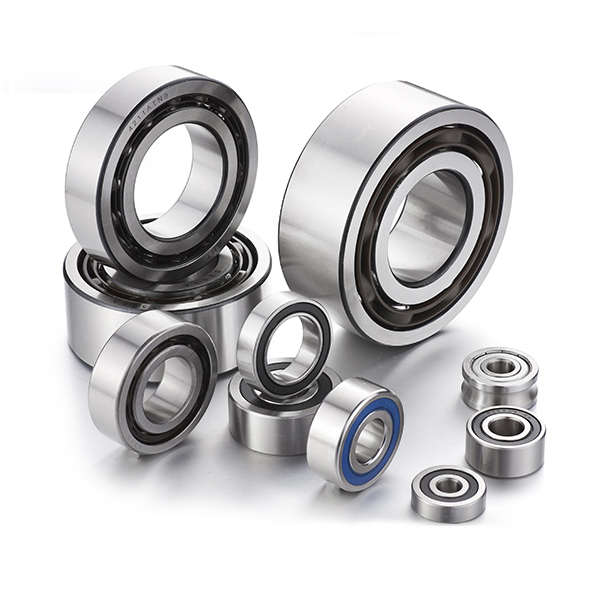
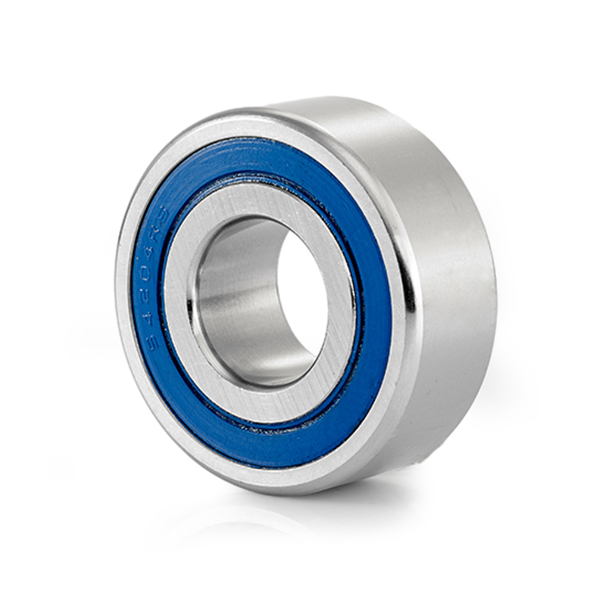
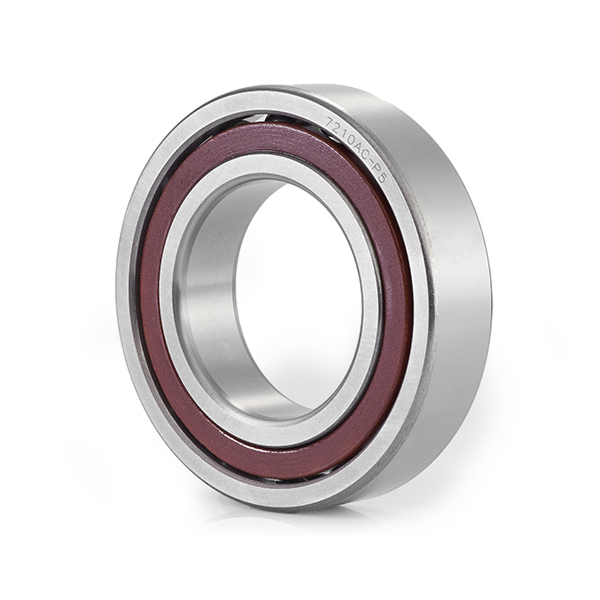
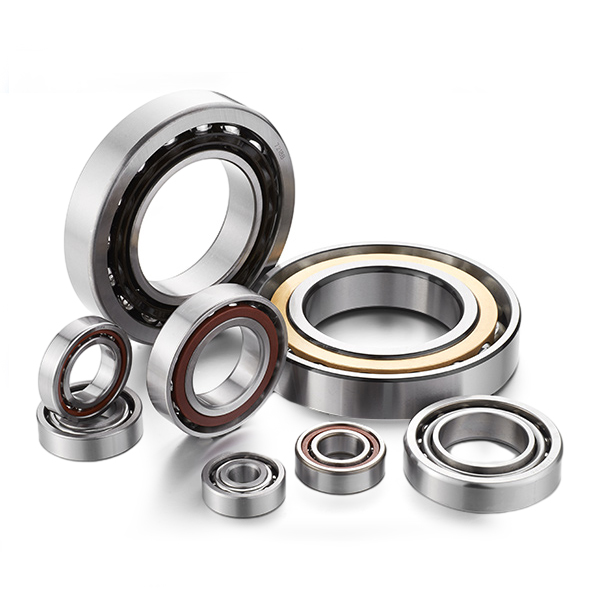
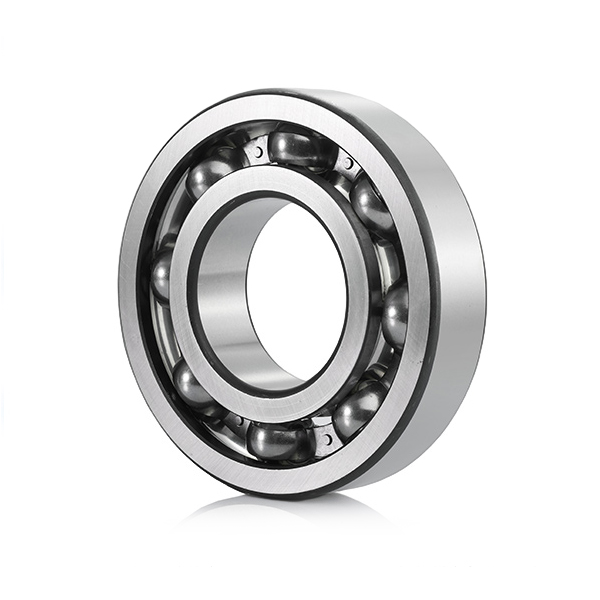
Deep groove ball bearings are the most widely used rolling bearing type in industrial and automotive equipment, and the reason comes down to geometry. A deep groove ball bearing has four basic components: an inner ring, an outer ring, a set of steel balls, and a cage that spaces the balls evenly. The raceway in each ring is machined as a continuous deep groove whose radius is slightly larger than the ball diameter. That deep cross-section means each ball contacts the raceway over a relatively large area, which lets the bearing accept loads from several directions without complex mounting arrangements.
Compared with other ball bearing families, the difference is clear. Angular contact ball bearings raise one raceway shoulder to carry heavy one-directional thrust, which normally requires paired mounting. Self-aligning ball bearings use a sphered outer raceway to tolerate shaft misalignment but give up some load capacity. A deep groove ball bearing sits between them: compact, capable of combined radial and axial loads, fast, quiet, and low in friction. That combination in one simple package explains why deep groove ball bearings dominate general machinery.
The operating principle is simple: rolling replaces sliding. As the shaft rotates, the balls roll along the raceway grooves, converting sliding friction into rolling friction. Rolling friction consumes much less energy and produces much less heat, which is why these bearings sustain high rotational speeds without overheating.
The deep groove geometry does more than guide the balls; it also manages load direction. Under radial load, the balls stay seated in the groove and transfer the load smoothly from the outer ring to the inner ring. Under axial load, the load path shifts to the side walls of the groove, which is how a standard deep groove ball bearing supports moderate thrust loads in both directions. If axial loads are large and predictable, an angular contact bearing is a better choice; for general mixed-load conditions, the deep groove design is the more economical answer.
The cage keeps the balls evenly separated, prevents direct ball-to-ball contact, and holds each ball on its correct track. Cage material and design directly influence the speed limit and long-term reliability.
Lower friction also means lower operating temperature. Heat degrades lubricant and changes internal clearances, so a bearing that generates less heat at speed has a clear reliability edge in continuous duty.
Not every deep groove ball bearing is identical. Manufacturers offer design variations that solve specific operating problems. The table below summarizes the main types and the conditions they address.
| Design variation | Main purpose |
|---|---|
| Single-row standard | Default choice for radial and light axial loads in general machinery. |
| With snap groove, snap ring | Axial location and simplified housing design in confined spaces. |
| With filling slots | Higher radial load capacity by fitting more balls. |
| Double-row | Higher radial capacity and improved shaft rigidity. |
| Expansion-compensating | Handles relative axial displacement from thermal differences. |
| High-speed low-friction torque | Reduced friction torque and heat for high-speed operation. |
Single-row standard type. This is the default form. It handles predominantly radial loads with moderate axial capacity in pumps, fans, gearboxes, and general machinery.
With snap groove and snap ring. A snap groove is machined into the outside diameter of the outer ring, and a snap ring fits into that groove to locate the bearing axially in the housing. This removes the need for a separate housing shoulder and simplifies assembly in confined spaces. For installations where axial positioning must be simple and compact, deep groove ball bearings with snap ring are a practical solution.
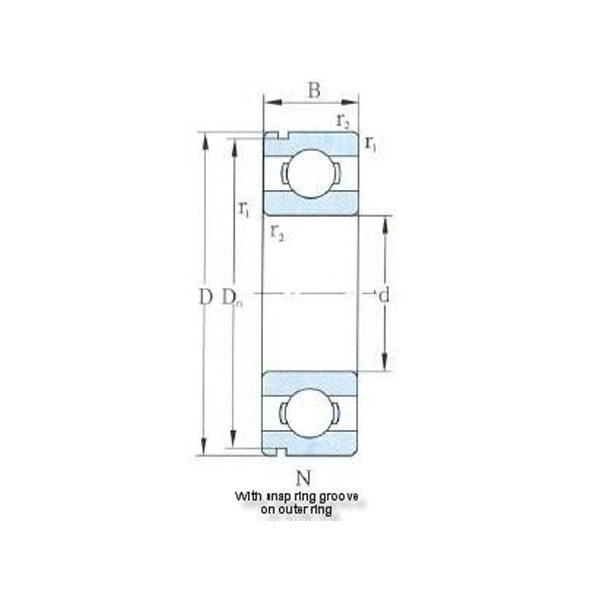 Wholesale Deep groove ball bearing with snap groove & snap ring on outer ring SuNingbo Demy (D&M) Bearings Co., Ltd. is China wholesale Deep groove ball bearing with snap groove & snap ring on outer ring suppliers an...View Product →
With filling slots. Filling slots are cut into the raceway shoulders so more balls can be loaded into the bearing. More balls mean higher radial load capacity. The trade-off is reduced axial capacity because the slots interrupt the shoulder that normally carries thrust. Choose deep groove ball bearings with filling slots when radial loads dominate and axial loads are minimal.
Double-row design. Two rows of balls share the load, giving higher radial capacity and better shaft rigidity for heavier gearboxes and machine tool spindles.
Expansion-compensating type. When the shaft and housing run at different temperatures or use materials with different expansion rates, relative axial movement occurs. The expansion-compensating design accommodates that displacement while maintaining load support.
High-speed low-friction torque type. Internal geometry is optimized to reduce friction torque and heat generation at high speed. This variant targets spindles, blowers, and energy-sensitive equipment.
A standard model such as a chrome steel 6311 bearing represents the basic single-row design that these variants build upon; the differences appear when application conditions change.
To review the complete family, browse our deep groove ball bearings range.
OEM/ODM Deep Groove Ball Bearings Manufacturers, FactoryNingbo Demy (D&M) Bearings Co., Ltd. is China Deep Groove Ball Bearings manufacturers and Deep Groove Ball Bearings factory, we offer OEM...View Product →Choosing the right bearing starts with the operating condition, not the part number. Use these factors as a checklist.
Define the load direction first. Mostly radial with light axial content points to a standard single-row bearing. Higher radial load and extra shaft rigidity point to double-row deep groove ball bearings, which add capacity with only a modest increase in width. Heavy, consistent axial load points to an angular contact bearing instead.
Speed amplifies friction and heat. For continuous high-speed duty, choose a low-friction design with a suitable cage and lubricant. High-speed low-friction torque deep groove ball bearings use optimized internal geometry to keep temperature rise in check and extend lubricant life.
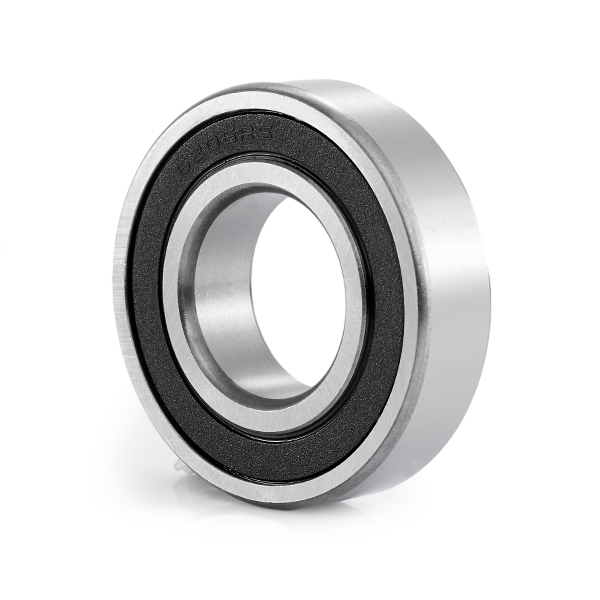 Wholesale High speed low friction torque deep groove ball bearings Suppliers, MaNingbo Demy (D&M) Bearings Co., Ltd. is China wholesale High speed low friction torque deep groove ball bearings suppliers and High spee...View Product →
Sealing is a trade-off between protection and friction. Open bearings offer the lowest friction but need clean surroundings. Shielded types (ZZ) keep out coarse particles with little drag. Contact seals (2RS) resist fine dust and moisture but add friction torque. A dusty site calls for a sealed bearing; a clean, fast motor may run better with a shielded design.
Large temperature differences between shaft and housing create relative axial movement. In those conditions, an expansion-compensating type prevents internal preload and early failure. Evaluate the entire operating range, not just the average.
When the housing cannot provide a locating shoulder, or the assembly must remain narrow, a snap ring on the outer ring provides axial location without extra components. Also review mounting method, tolerance class, and whether axial retention is required.
Precision ground raceways reduce vibration, which directly lowers noise. For household appliances and electric motors, specify tighter noise and vibration grades. Ball quality, cage type, and internal clearance all influence the acoustic result.
Deep groove ball bearings appear in nearly every rotating machine, but four industries use them in particularly large volumes.
Automotive. Alternators, clutch systems, water pumps, and wheel-related assemblies all use deep groove ball bearings. Automotive operating conditions include wide temperature swings, vibration, and contamination, so manufacturers with automotive-grade quality systems are preferred in this sector.
Electric motors and household appliances. Motor rotors demand low friction and low noise, and small appliances add cost pressure. Standard single-row bearings cover most motor duty, while low-friction variants handle the high-speed end of the range.
Agricultural machinery. Dust, moisture, and shock loads make sealing a priority in farm equipment. Dedicated agricultural deep groove ball bearings are built with reinforced sealing and robust raceways to survive these conditions over long seasons.
General industrial machinery. Pumps, fans, conveyor rollers, compressors, and gearboxes rely on deep groove ball bearings as a standardized, interchangeable workhorse. Availability, predictable life, and simple replacement matter most here.
The bearing spec only becomes a usable product through a manufacturer's process. Evaluating the supplier is as important as evaluating the part.
Quality system certification. ISO/TS 16949 certification is a strong signal that a manufacturer's quality management system meets automotive-industry standards for process control and traceability. It demonstrates that tolerances and inspection routines are documented and consistently applied.
Production capability. Real manufacturing scale shows up in production floor area, automated assembly lines, and in-house testing equipment. A manufacturer that machines, assembles, and inspects in one controlled environment delivers batch-to-batch consistency more reliably than one that only assembles bought-in components.
Product range breadth. A supplier offering snap-ring, filling-slot, double-row, expansion-compensating, and high-speed variants demonstrates an understanding of how operating conditions change the bearing design. That depth improves technical communication when a non-standard requirement appears. A common part like a chrome steel 6311 deep groove ball bearing is straightforward to supply; the ability to provide specialized variants alongside it indicates broader engineering capability.
Responsiveness and development speed. Real sourcing projects involve samples, modified designs, and schedule pressure. A supplier that answers technical questions quickly and moves samples fast lowers the project risk before the first production order is even placed.
Deep groove ball bearings earn their position as the default rolling bearing because they are simple and versatile. They carry combined radial and axial loads in a compact package, run quietly at high speeds, and come in design variants that address specific engineering problems: snap rings for easy installation, filling slots for higher radial load, double-row construction for rigidity, expansion-compensating types for thermal movement, and low-friction designs for energy-sensitive high-speed duty.
Selection does not need to be complicated. Start with three questions: what direction and magnitude is the load, what speed range must be sustained, and what sealing level does the environment require. Those three answers narrow the field to one or two appropriate variants.
When in doubt, bring real operating conditions to a bearing supplier rather than just a part number. Load, speed, temperature, and environment are enough information for an experienced manufacturer to confirm whether a standard deep groove ball bearing fits or a variant is required.

Copyright © Ningbo Demy (D&M) Bearings Co., Ltd. All Rights Reserved.
 OEM/ODM Industrial Bearing Manufacturers

 Search
 EN
EN English
 Español